smartcybers786@gmail.com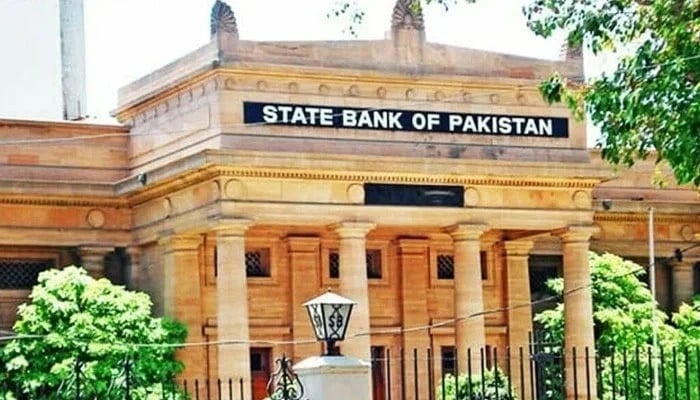
An undated image of the State Bank of Pakistan building in Karachi. — AFP
#SBP #policy #rate #unchanged
The State Bank of Pakistan’s Monetary Policy Committee left the policy rate unchanged at 11 percent on Monday, leaving borrowing costs steady.
The decision marked the fourth consecutive meeting with no changes, extending the pause in monetary easing as policymakers weigh potential inflationary pressures against signs of a fragile economic recovery.
The policy committee had reduced the interest rate to 1 percent in its meeting on May 5 this year.
As the outlook improves as flood impacts ease, risks remain
The MPC noted that headline inflation rose to 5.6 percent in August from September, while core inflation stood at 7.3 percent. The committee assessed that flood damage to the broader economy is smaller than previously feared, with crop losses likely to cause minimal supply disruptions, and high-frequency indicators showing strong momentum.
With earlier easing still transmitted through the economy, the MPC viewed the real policy rate as “appropriately positive” to guide inflation towards the 5–7% medium-term target, even as risks from tariff dynamics that challenge exports, and potential domestic supply frictions persist.
Since the last meeting, several developments have shaped the approach. The Pakistan Bureau of Statistics (PBS) has projected a growth rate of 2.7 percent to 3.0 percent of the gross domestic product (GDP) in fiscal year 2025 (FY25). Preliminary estimates for the major kharif crops remained close to last year’s output despite the floods. Notably, State Bank of Pakistan (SBP) foreign exchange (FX) reserves continued to increase even after the US$ 500 million Eurobond repayment.
Pakistan reached a staff-level agreement with the International Monetary Fund (IMF) on reviews of the Extended Fund Facility (EFF) and the Resilience and Stability Facility (RSF).
Meanwhile, the latest State Bank of Pakistan-Business Administration (SBP-IBA) sentiment survey on inflation and corporate inflation expectations showed mixed trends in global commodity prices and volatile oil prices.
Reservoirs climb along with the velocity
Recent high-frequency indicators point to sustained growth momentum, the statement said. The big kharif forecast turned out to be better than expected, confirmed by satellite imagery showing healthy vegetation. Improved prospects for rabi crops are supported by improved input conditions and expected post-flood yield increases.
In industry, large-scale manufacturing (LSM) expanded 4.4 percent year-on-year in July. August FY 2026 (FY 26), compared to a modest contraction a year ago.
Strong private sector credit and improved business sentiment, as well as strong sales of automobiles, cement, fertilizers and petroleum, oil and lubricants (POL) products have rounded out the industrial outlook, with expected spillover in services. On current trends, real GDP growth is now estimated to be in the upper half of the previously forecast range of 3.25%–4.25%.
The current account (CA) recorded a surplus of US$110 million in September 2025, narrowing the first quarter (Q1) of FY26 deficit to US$594 million, in line with expectations. Exports continued to grow moderately, while rapidly growing imports widened the trade gap. Labor remittances remained flexible.
Along with net financial inflows, this has increased SBP FX reserves to USD 14.5 billion as of October 17. Looking ahead, imports are likely to gain traction with activity, although flood-related import requirements appear lower than previously assumed, and the outlook for remittances has improved.
Overall, the current account deficit (CAD) is projected at 0-1% of GDP in FY26, with FX reserves expected to reach USD 15.5 billion by December 2025 and USD 17.8 billion by June 2026.
In Q1-FY26, tax collections grew by 12.5% year-on-year to Rs 2.9 trillion, which is Rs 198 billion below the target. According to the statement, higher SBP profit transfer and Petroleum Development Levy (PDL) receipts should boost non-tax revenue.
Both the overall balance and core balance are likely to post a surplus for the quarter. The MPC expects post-flood rehabilitation to be financed within budgetary resources and reiterates the need for continued fiscal discipline to meet balance sheet targets and secure long-term sustainability.
Broad money (M2) growth slowed to 12.3 percent as of October 10 due to a decline in net domestic assets of the banking system, mainly due to a sharp slowdown in bank credit to non-bank financial institutions (NBFIs).
Net budget borrowing remained contained, creating space for the private sector: private sector credit (PSC) growth increased to 17 percent, with significant demand in working capital, fixed investment and consumer loans, textiles, telecommunications, chemicals, and wholesale/retail trade.
On the liability side, currency in circulation increased year-on-year while deposit growth slowed, lifting the currency-deposit ratio (CDR) to 37.6 percent and raising reserve money growth.
Headline inflation rose to 5.6 percent in September, reflecting flood-related food price hikes, rising energy prices and sticky core inflation. Unlike previous flood episodes, food price hikes appear to be milder than feared, with the Sensitive Price Index (SPI) showing gradual increases in wheat and allied products, sugar and non-food items.
The MPC nevertheless expects inflation to cross the 5-7% band for a few months in the second half of FY26 (H2) before reverting to the target range in FY27. Key risks presented by the MPC include global commodity volatility, the timing and magnitude of future energy price adjustments, and uncertainty about wheat and perishable food prices.