smartcybers786@gmail.com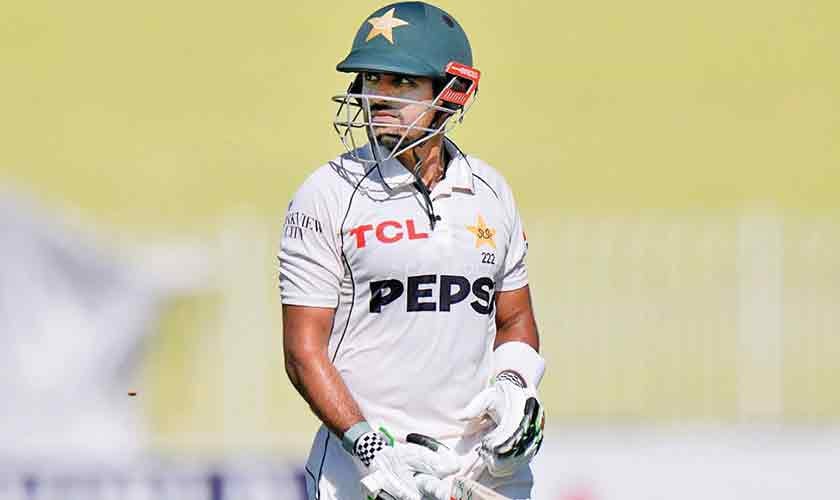
#Pakistan #afford #drop #Babar #Sports
After the retirement of Azim Inzam-ul-Haq, Mohammad Yousuf and Younis Khan who shared Pakistan’s batting burden for more than a decade, Babar Azam is the only batsman to claim his place in the middle order.
Since then, Babar Azam has been a cornerstone of Pakistan’s batting line-up, his elegant strokeplay and unforgiving technique making him one of the world’s elite batsmen.
Still, as his form ends in 2025, questions arise over his place in the team and whether Pakistan’s selectors can afford to let go of their biggest star. The dilemma is: stick with a proven but underperforming asset, or gamble on untapped potential?
The statistics paint a disturbing picture of Babur’s recent struggles. In the early stages of Pakistan Super League (PSL) 2025, he recorded a series of uncharacteristically low scores, including scores of 0, 1, and 2, in consecutive T20 matches.
This form continued in international cricket. During the ODI tri-series in February 2025, he managed just 62 runs in three matches at a sub-par 20.67.
Similarly, his tour of the West Indies in August 2025 saw him post scores of 47, 0 and 9 in the three-match ODI series. While those stats are temporary blips on an otherwise stellar career, they indicate a player struggling for confidence and rhythm.
He was ruled out of the Asia Cup 2025, as head coach Mike Hesson termed Babar’s exclusion as a “tough decision” who acknowledged the right-hander’s stature but identified the need for improvement.
Babar is told about the selectors. “It requires the decision team to increase their strike rate and stabilize their game against spin,” Hessen said.
The decision comes in the wake of Pakistan’s early elimination from the 2024 T20 World Cup, following their crushing defeat in the 2022 final. The statistics underline this concern: Since 2020, Pakistan’s top three batsmen have faced nearly three-quarters of the team’s delivery.
The reluctance to drop a player of Babar’s caliber is understandable. His career statistics are astounding, especially his ODI average of 54.23, making him one of the best in the format. He also has impressive T20I (39.83) and Test (42.87) averages, cementing his status as a premier multi-format batsman.
However, with the Pakistan team’s performances coming under increasing scrutiny, especially after disappointing showings in global tournaments, relying on past glories is a luxury the selectors may not have.
Pakistan’s star batsman and former captain, Babar Azam has been facing a dip in form recently, which has raised concerns among fans and cricket experts alike. His consistent performances over the years have been the backbone of Pakistan’s batting line-up, making it a major challenge for the team in its current struggles. Despite his poor form, there is a notable lack of suitable replacements within the current squad.
A number of emerging players have shown promise, but none have yet shown the consistency or flexibility needed to fill Babar’s shoes at the international level.
Team management is caught in a dilemma – while they recognize the need for strategic change, they are reluctant to replace a key player without a credible replacement.
The situation points to depth issues within Pakistan’s cricket pipeline and highlights the difficulty of finding someone who can match Babar’s skill, temperament and leadership qualities.
The absence of a clear successor puts extra pressure on the squad and coaching staff, especially during crucial series. It also emphasizes the importance of nurturing young talent and ensuring a smooth transition when experienced players face a dip in form. For now, Pakistan continues to hope that Babar Azam has regained his prime, but finding an effective replacement for him remains a nagging concern.
The debate surrounding Babar Azam’s form and future is a microcosm of Pakistan cricket’s sustainable selection challenges. Dropping him risks losing a world-class anchor, while keeping him in poor form can jeopardize the team’s balance and results.
While navigating the political pressures swirling around Pakistan cricket, selectors must weigh statistical evidence against its track record. For now, the question of who could potentially replace Babur is a complex puzzle with no easy solution.
In Pakistan cricket, Babar Azam stands as the cornerstone of the batting line-up, his consistent performances with the bat have been instrumental in Pakistan’s victory in several international matches. Despite occasional criticism of his strike rate, Babar’s technique, composure under pressure, and ability to stabilize high innings made him somewhat irresistible.
Currently, there is no viable replacement for Babar Azam in Pakistan’s middle order, especially in the longer version of the game. He lacks the depth of talent needed to fill his shoes, as neither the emerging nor the established cricketer has shown the same level of consistency and composure. The team management recognizes his importance not only as a run scorer but also as a leader who guides the younger players.
Investing in the character of Babar Azam is crucial for Pakistan’s future success. Removing him from the team at this stage would risk destabilizing the batting order and could hamper the team’s performance in future series and tournaments.
With a cricketing strategy that emphasizes stability and experience, Babar Azam’s status is secure—at least for now—as Pakistan’s most important middle-order batsman.
Babar has seen a dip in his batting form across all formats and has failed to score an international fifty in his last 10 innings.
Babar stepped down as captain of all three formats last year after Pakistan failed to make the knockout stages of the ICC Cricket World Cup in India, before returning as white-ball captain in March ahead of the ICC T20 World Cup in the United States and the West Indies, where Pakistan failed to make it past the preliminary group stage.
Pakistan won just six of the 13 Twenty20 (T20i) matches they played under Babar in his second tenure. Pakistan has not played a one-day international since the 2023 World Cup.
Babar’s past captaincy record speaks for itself. Under his leadership, Pakistan defeated India for the first time in a World Cup encounter in the ICCT20 World Cup 2021. In the 2022 T20 World Cup, he led the team to the final. It was Pakistan’s first World Cup final since 2009.
In T20Is, he led the team 71 times, winning 42. This includes two final losses in the Asia Cup and World Cup, and a semi-final loss in the 2021 World Cup.
There is no doubt that Babar is a much better player than the captain. Babur should learn how to change the batting order and bowling plans according to the situation. He is still in the process of learning the art of leadership, especially in moments of crisis.
Babar has struggled to maintain his form, particularly in Test cricket. His performance in the home Test series against Bangladesh was particularly disappointing, managing just 64 runs (0, 22, 11, and 31) in four innings.
He has not scored a half-century in his last 16 Test innings. Adding to the pressure, Babar dropped out of the ICC top 10 rankings for batsmen for the first time in years. However, Babar’s top-scorer’s solid and timely knock of 42 in Pakistan’s second innings in the first Test against South Africa bodes well.
Pakistan’s overall decline in Test cricket has also mirrored Babar’s struggles. The team recently moved up to the eighth position in the ICC Test Team Rankings.
khurms87@yahoo.com