smartcybers786@gmail.com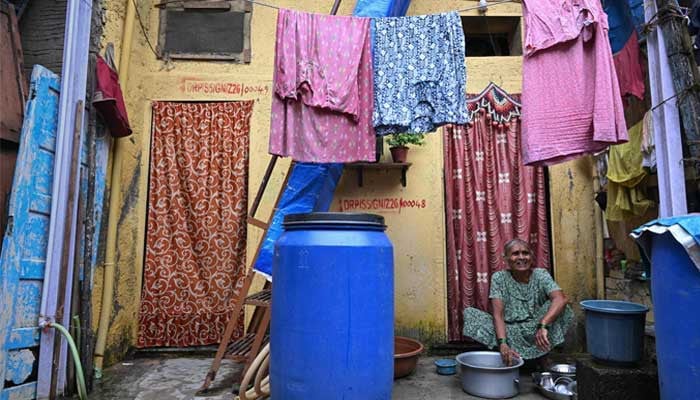
This image shows a resident, eligible for relocation under an urban renewal project, washing utensils outside her house marked for redevelopment in Dharavi, a slum settlement in Mumbai, India on July 9, 2025.
#Asias #largest #slum #Mumbai #sale
MUMBAI: Only above the stairs of the stairs, the red mark in the Dharavi Katchi population of Mumbai is equivalent to evacuation notice for residents like Bipnomer Padia.
“I was born here, my father was born here, my grandfather was born here,” said a 58 -year -old civil servant.
“But we have no choice, we have to empty.”
Soon, bulldozers are expected to roam in the largest Katchi population in Asia, in the heart of Mumbai’s Indian megalopolis, which has flashed the maze of its dirty streets for a new neighbor.
The restoration scheme, led by Mumbai officials and billionaire Ticon Gautam Adani, reflects modern India.
If it moves forward, many millions of people and workers of Dharavi will be overthrown.
Padia said, “They told us that they would give us houses and then they would develop the area.”
“But now they are building their planned areas and trying to get us out. They are deceiving us.”
On the edge of Dharavi, a Padia -floor house is so tight in the streets of the streets that the sunlight is barely filtered.
The engine room and underbully
Padia says his ancestors settled in Dhravi fishing in the 19th century, escape from hunger and flood in Gujarat, 600 km (370 miles) north.
The waves of immigrants have given flowers to the district since then it is absorbed in Mumbai, now it has 22 million people.
Today, this spread covers 240 hectares and has the highest density of the population in the world.
Houses, workshops and smaller factorys are trapped between each other, two railway lines and a trash.
Over the decades, both the Dharavi engine room and the Indian financial capital have become influenced by both.
The icon shows a resident, who is eligible to relocate under the urban renewal plan, was washed out of his house on July 9, 2025, in Mumbai, India, a raw population in Mumbai.
Potters, tanners and recycles worked to fire, hide, hide, or eliminate scrap, to treat informal industries that generate an annual estimate of $ 1 billion.
British director Danny Boyle appointed his 2008 Oscar-winning film “Saldog Millenier” in Dharavi-this is a photo called a resident called a carcat.
For them, the district is unconscious and poor – but full of life.
Padia said, “We live in a raw population, but we are very happy here. And we don’t want to go.”
‘City within a city’
Five minutes away from Padia’s house, saving the corrugated sheets over the cranes tower.
Dharavi’s restoration work is underway-and in the central office of its vast city, SVR Srinivas insists that the project will be ideal.
“This is the world’s largest urban renewal project,” said the chief executive of the Dharavi Reconciliation Project (DRP).
“We’re building a city inside a city. This is not just a Kachi population development project.”
Broosers show new buildings, paved roads, green places and shopping centers.
“Every family will get a house,” Srinivas promised. “The idea is to resettle millions of people as far as possible, as far as possible, within the direction.”
He added – even though business will remain in tough circumstances.
Prior to 2000, families living in Dharavi will get free accommodation. People who arrived between 2000 and 2011 will be able to buy at a “low” rate.
Newcomers will have to rent somewhere else.
‘House for a house’
But there is another important situation: only the owners of the ground floor are eligible.
Half of the Adiva people live or work illegally built or work.
Manda Sunil Bhu meets all the requirements and beams on the possibility of leaving his tight two -room flats, where there is no place to open the bed.
“My house is small, if a guest arrives, it’s shameful to us,” said a 50 -year -old boy in a blue saree.
“We have been told that we will find a house in Dharavi with the toilet … It has been my dream for many years.”
But many of his neighbors will be forced to leave.
Elish Gajakosh, who leads the “Save Dhrovi” campaign, demands “a house for a house, a shop for a shop”.
“We want to get out of the Katchi population … but we do not want them to get us out of the name of development. This is our land.”
Gajakosh counts on the support of local businesses, including 78 -year -old leather worker Wahaj Khan.
“We employ 30 to 40 people,” he said, looking around his workshop. “We are ready for development. But if they do not give us a place in Dharavi, our business will end.”
‘A new Dharavi’
Abbas Zakaria Galwani, 46, is also involved in the same concern.
He and 4,000 other Dharavi’s potters also refused to participate in the census of their property.
“If Adani does not give us such a place, or moves us somewhere, we will lose,” Galwani said.
More than local authorities, this is Adani – the billionaire tycoon behind the party – which has become an electric rod for criticism.
His fortune has increased since Prime Minister Narendra Modi took office in 2014. So it was not surprising that when his group won the Dharavi contract, which promised to invest about $ 5 billion.
Adani has gained 80 % of the shares in the project, the state government has overcome the rest. It is estimated at $ 7-8 billion at a total cost and is expected to be completed in seven years.
It has publicly pledged his “good intentions” and has promised to create a new “dignity, safety and involvement.”
Shakees suspect that it is after a lucrative real estate.
The Dharavi Bandra-Corla is sitting on the prime land along with the Business District.
“This project has nothing to do with the improvement of people’s lives,” said Shiva Damale, the welfare association of residence and livelihood.
“That’s only a few people to improve business.”
He believes that “best” three -quarters will be forced to leave.
He warned that “a whole environmental system will be over.” It would be a catastrophe. “